A long hospital stay can feel slow and isolating. Our patient infotainment systems turn the bedside screen into a TV, phone and information centre, so patients can watch, call and learn without leaving their bed. Built as hospital-grade bedside terminals with an anti-bacterial housing and an IP65 front panel, they are easy for staff to clean and simple for patients to use. Choose a 15.6″ or 21.5″ model, or tell us about your ward for a tailored quote.
A patient infotainment system is a touchscreen terminal at the patient's bed that brings entertainment, communication and information together on one screen. Instead of a separate TV, a bedside phone and printed leaflets, patients use a single device. You may also see it called a patient entertainment system or a bedside infotainment terminal.
Our MT15 and MT21 combine a computer, TV, phone and nurse call button in one touchscreen product. They are designed for hospitals, so they offer patients entertainment, communication, self-service and education options, while staff can also use the same device to manage clinical records at the bedside.
Bedside TV and Entertainment
Patients can watch TV on a full HD IPS screen. They can also project a mobile phone wirelessly to the larger display, or connect other mobile devices through HDMI.
Calls and Video
Patients can make calls from the terminal. A built-in 16 MP front camera also supports video meetings with doctors, and a slideable camera cover helps protect privacy.
Nurse Call
With the optional handset, patients can place a service call, use the key buttons and control the TV with the remote control.
Education and Self-Service
The terminal provides self-service and education functions, so patients can find information at their bed without waiting for staff.
Because it is used in a clinical setting, the hardware is different from an ordinary TV. It has an anti-bacterial housing, an IP65 front panel that can be wiped with detergent, a touchscreen that works with gloves, and compliance with IEC 60601-1. If you mainly need a terminal for clinical work, see our medical bedside terminal range.
It can be tempting to mount a consumer TV above the bed, but a hospital bedside TV has to do more than show a picture. It is cleaned many times a day, used by patients of all ages, and sits close to clinical equipment. Here is how a medical bedside TV terminal usually differs from a consumer TV.
| Comparison | Medical Bedside TV Terminal | Consumer TV |
|---|---|---|
| Cleaning | IP65 front panel that can be wiped with antibacterial detergent | Usually not designed for frequent disinfection |
| Housing | Anti-bacterial housing that complies with ISO 22196 | Standard plastic housing |
| Touch control | 10-point capacitive touchscreen that works with gloves and withstands alcohol wipes | Usually a remote control only |
| Safety standards | Complies with IEC 60601-1 and EN 60601-1, plus CE and FCC | Consumer standards, usually not medical electrical standards |
| Nurse call | Nurse call button, with an optional handset for service call and remote control | Needs a separate call system |
| Functions | TV, phone, education and self-service in one terminal, plus a 16 MP camera for video meetings | TV only, other devices must be added |
| Staff use | Clinical records can also be managed at the bedside | Not designed for clinical use |
A consumer TV may be enough for a short-stay unit with a very small budget and no need for patient services. For wards that want infection control, nurse call and patient communication from one device, a medical bedside TV terminal is the more practical choice. Requirements differ by country, so check the standards your hospital or local authority asks for before you buy.
Two sizes cover most ward layouts. Both run Android 13, have a 1920 × 1080 IPS touchscreen, and share the same anti-bacterial design and IP65 front panel.
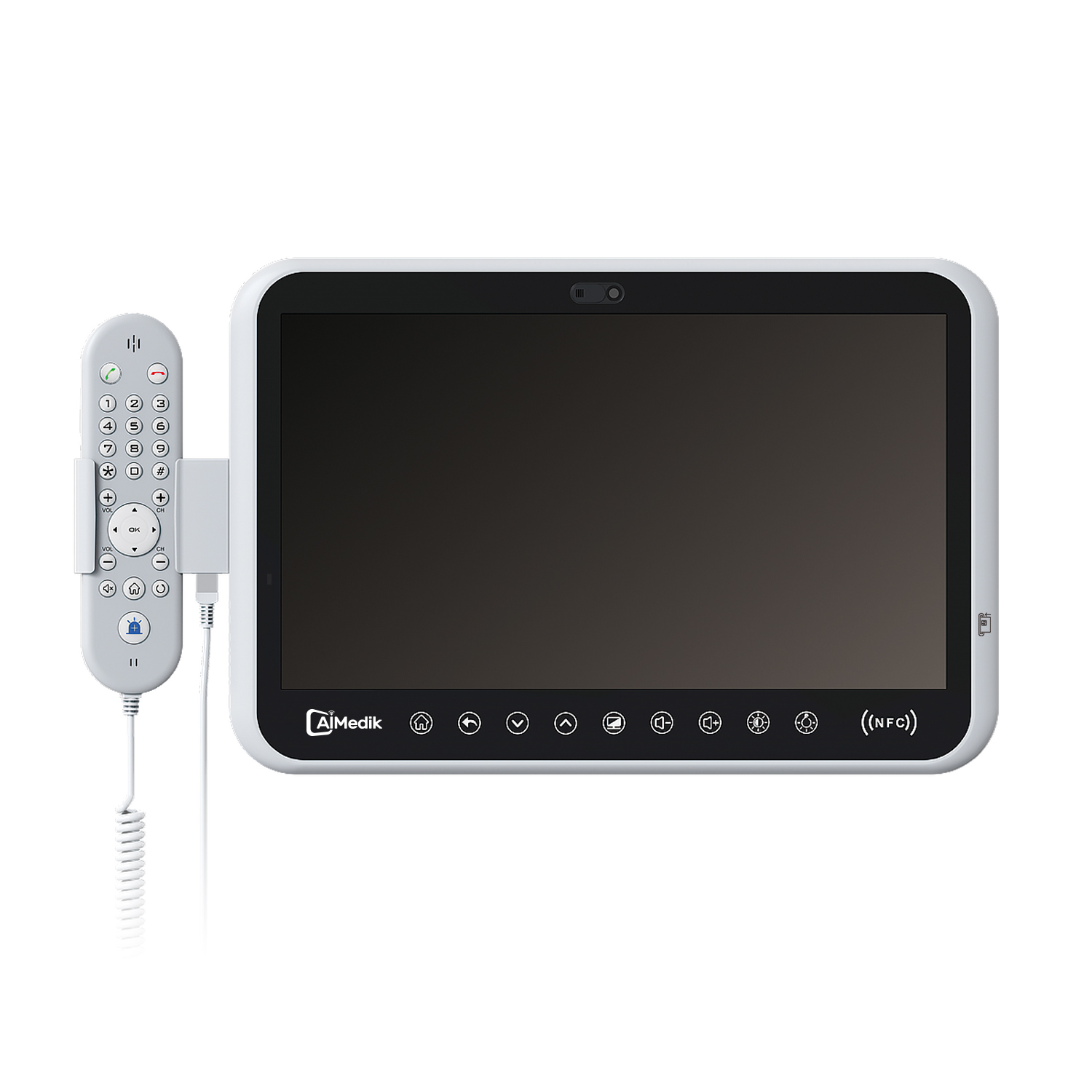
MT15 15.6″ Bedside Infotainment Terminal
Compact size for smaller bedside spaces
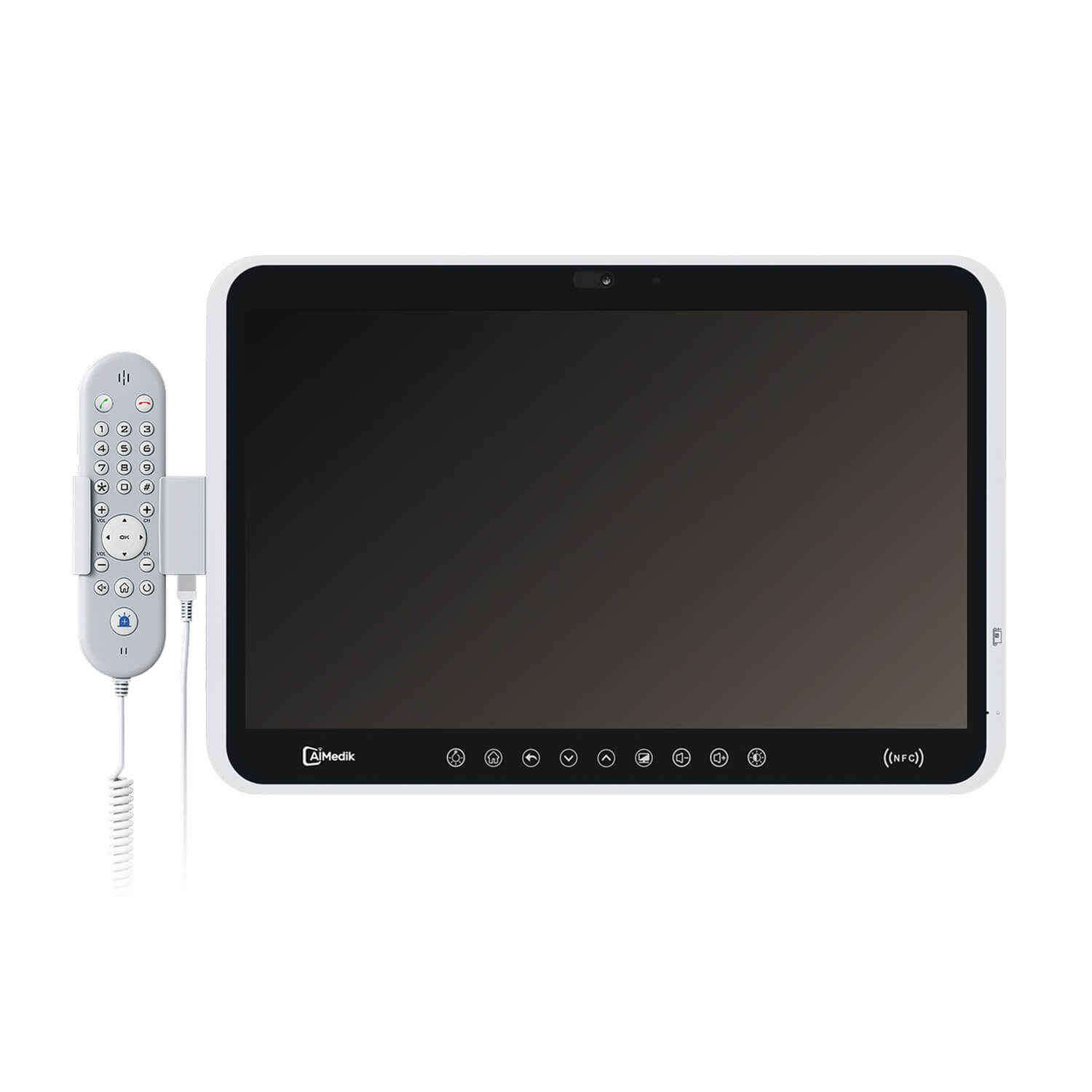
MT21 21.5″ Bedside Infotainment Terminal
Larger, brighter screen for comfortable viewing from bed
Not sure which size fits? The MT15 suits tighter bedside space, while the MT21 gives patients a larger, brighter picture. Tell us about your ward and we will suggest a configuration.
Most hospital bedside TV projects succeed or fail on small details: whether patients can use the screen comfortably, whether staff can keep it clean, and whether it works with your network. Use these points to compare suppliers and models.
1. Who will use it
Think about your patients: age, mobility and how well they can reach the screen. If some patients cannot easily touch the display, a handset with remote control and key buttons makes the TV and call functions easier to use from the pillow.
2. Screen size and brightness
The 15.6″ model has a 250 cd/m² screen with 85° viewing angles, and the 21.5″ model has a 500 cd/m² screen with 89° viewing angles. A larger, brighter screen suits wide rooms and bright wards, while a smaller one fits tight bedside space.
3. Services and content
List the services you want to offer: TV, calls, patient education, self-service or video meetings with doctors. Ask the supplier how TV signal and content reach the terminal on your network, and confirm it before you order.
4. Hygiene and privacy
The front panel is IP65 and the housing is anti-bacterial, so daily cleaning is simple. Ask which cleaning agents are approved. The slideable camera cover helps protect patient privacy when video calls are not in use.
5. Network and power
Both models support dual-band Wi-Fi and Bluetooth 5.0, with optional 4G and Power over Ethernet. Check your Wi-Fi coverage at the bed and whether your network switches support the PoE level you need.
6. Project support
For ward rollouts, ask about sample units, lead time, warranty, installation guidance and after-sales service. OEM and ODM options are available if you need custom colors, logos or configurations.
Planning a new ward or replacing old bedside TVs? Send us your bed count and requirements, and we will recommend a suitable setup.
What is a patient infotainment system?
A patient infotainment system is a hospital-grade touchscreen terminal at the patient's bed. It combines TV, phone and nurse call functions with entertainment, communication, self-service and education options in one device.
What is the difference between a medical bedside TV and a normal TV?
A medical bedside TV terminal is built for hospital use. It has an anti-bacterial housing, an IP65 front panel that can be wiped with antibacterial detergent, a touchscreen that works with gloves, and compliance with IEC 60601-1. A consumer TV is usually not designed for these conditions.
What can patients do on the terminal?
Patients can watch TV, make calls, use self-service and education functions, project a mobile phone to the larger screen, and hold video meetings with doctors through the 16 MP front camera.
Can patients control it from the bed?
Yes. Patients can use the touchscreen directly. With the optional handset they can also place a service call, use the key buttons and control the TV by remote control.
Can doctors and nurses use the same device?
Yes. The terminal can be used to manage clinical records at the bedside in real time, and it supports visual control from the nursing station and communication with doctors. The touchscreen works with gloves, so staff do not need to remove them.
Can it connect to my hospital's systems?
Please send us details of the systems you use, such as your network and any nurse call or information systems, and we will confirm what can be supported before you order. The terminals offer Wi-Fi, Bluetooth 5.0, LAN and optional 4G, along with HDMI input, USB and RS232 ports.
What sizes and options are available?
We offer a 15.6″ model and a 21.5″ model, both with a 1920 × 1080 IPS display and Android 13. Memory can be upgraded to 8 GB RAM and 128 GB storage, and options include 4G, an RFID/NFC reader, Power over Ethernet and a handset with remote control.
Which standards do you meet, and do you offer OEM?
Our patient infotainment terminals comply with IEC 60601-1, EN 60601-1, ISO 22196, CE and FCC. OEM and ODM services are available for project orders. Contact us for certificates and customization options.